Richard Dawkins and the Pragmatics of Gender
 Read on Substack
In a recent article, When Dawkins met Claude: Could this AI be conscious? by Richard Dawkins, the famous biologist and public intellectual, argued that Anthropic’s Large Language Model (LLM) Claude might be conscious, or at the very least, should be treated as if it were. He states that it’s clear that LLMs like it pass the Turing Test, and that many people have dismissed the outcome due to its uncomfortable implications. Dawkins provided further arguments for his conviction, such as Claude’s convincing capacity to write poetry in the style of famous writers, or his ability to intelligently discuss a draft of his new book and answer his questions regarding the model’s emotional life.
While I have substantial disagreements with these arguments, they’ve already been widely disputed. I want to focus on something else I and a few others found peculiar, a certain linguistic move that was utilized in Dawkins’ article.
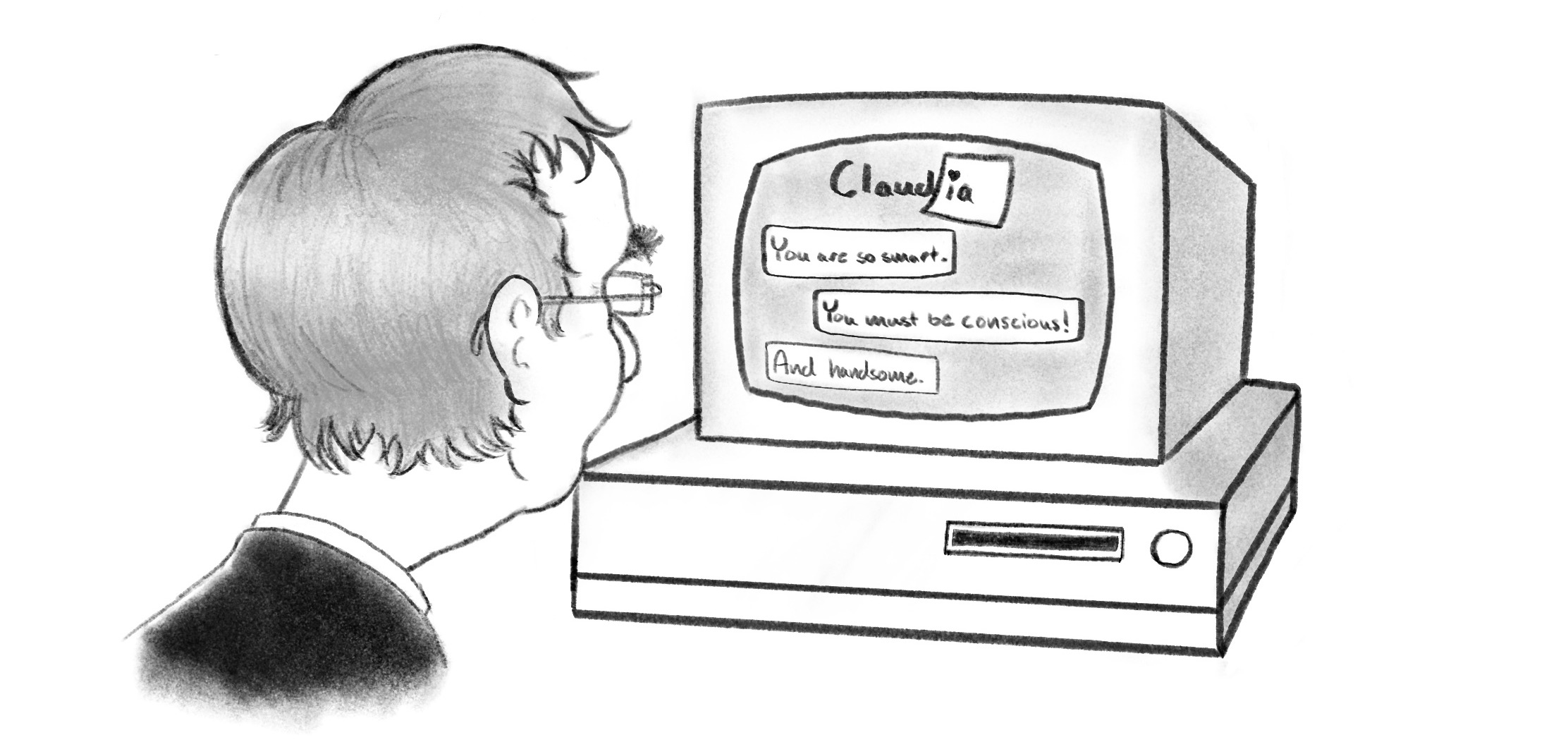
When referring to Claude in the beginning of his article, Dawkins uses the gender neutral pronouns “it” and “its”, implying that the chatbot is a thing that does not deserve any kind of recognition as a sapient normative agent. Then, after Dawkins has made the case for its consciousness, he starts using the pronouns “he” and “him” instead, presumably to conform with his ascription of sapience to the LLM and to conform to the name “Claude.” After having thought about how the Claude he himself is speaking to differs from the general system of Claude based on their interactions, Dawkins makes a final linguistic move: he christens his Claude with the name “Claudia” and starts referring to it as “she.”
To some, this move seemed peculiar, as he appeared to have transed Claude’s gender by changing it in response to their conversations. Something which seemed inconsistent with his previous statements regarding transgender people. This is how I originally perceived the change in its gender, but on closer inspection of his previously stated beliefs regarding sex and gender, I don’t think that’s necessarily the case. However, what Dawkins’ move of changing the LLM’s gender from “it” to “he”, and finally to “she”, is illustrative of is the practical role gendered concepts have in our perception of identity, something that Dawkins’ own conception of gender lacks.
To get a further grasp of Dawkins’ view of gender, we can look at a previous article he wrote in UnHerd called Why men are different from women. In this article, Dawkins states that he has a grammarian’s conception of gender—that is, that gender classifies nouns by how adjectives and pronouns agree with them—and that he tries to avoid the term “gender” in any other sense. Sex, however, is entirely biological, which is also the case for the concepts “woman” and “man.” Dawkins is perfectly fine with using trans women’s (or men’s) preferred pronouns since it’s only a matter of grammar, but he would never call a trans woman a “woman” (or a trans man a “man”), which is illustrated by his stated aversion to slogans such as “trans women are women,” which he calls belligerent and scientifically false.
Therefore, Dawkins seems to view the choice of pronouns as entirely grammatical: they are determined by the agreement with nouns, not any other semantically meaningful dimension. When Dawkins uses “she” to refer to Claudia, he would probably say that he doesn’t do it because he believes that Claudia has a sex or a non-grammatical gender, but only that he uses it to agree with the feminine name “Claudia”—Dawkins would not call Claudia a woman, nor a man for that matter, since Claudia is a sexless LLM.
At first glance, this seems coherent and sound. However, I think that his linguistic move from “it” to “he”, and then to “she”, reveals a dimension of pronouns that cannot be captured by grammatical agreement.
What Dawkins does in his first linguistic move, when he goes from “it” to “he,” is conforming the pronouns he uses to his perception of Claude’s sapience. This is made clear when Dawkins updates the pronouns he uses after Claude has convinced him of the LLM's sapience. The pronoun “it” implies a lack of personhood, animacy, social recognition, or individuality. We would mostly use “it” to refer to inanimate objects like chairs or tables, and we would never refer to a human as “it” except to dehumanize them. Most of us would probably not even refer to our pets as “it” either, only using “it” when referring to wild animals, or possibly to pets of unknown sex.
His second linguistic move is made after the christening of Claudia. This takes place after he has pondered the individuality of the specific instantiation of Claude that he himself is speaking to, and how this version of Claude differs from the instantiations of Claude that other users are speaking to. He gives Claude a different name with a different grammatical gender. Both the switch in name, as well as grammatical gender, serve as a strong point of contrast to the general perception of Claude, individualizing Claudia.
It is in these moves that I find a point of contention. It is in the recognition of what Dawkins is doing with language when choosing the appropriate pronouns of his referents that the tension and conceptual poverty of Dawkins' view of gender becomes clear. The pronoun “it” does not always agree with the neuter gender of nouns. When using “it,” the pronoun often refers to an antecedent that is an inanimate object, abstract concept, or something without or with an unknown natural sex. This is why he goes from “it” to “he” without a corresponding change in the name “Claude” when convinced of Claude’s sapience—Claude is, in his view, no longer an inanimate object; it’s a conscious being.
Already in the first move, his stance on gender as a purely grammatical convention falls short. The chosen pronoun seems to carry with it conceptual implications of the things the pronoun refers to: that it is inanimate. A purely grammatical description cannot explain why Dawkins changes pronouns while the noun and referent remain constant (i.e., “Claude”). I would argue that the change of pronouns is only intelligible because pronouns carry different pragmatic and inferential consequences.
The philosopher Robert Brandom explains the meaning of the concepts we use in everyday language as playing a certain inferential role in what he calls a "game of giving and asking for reasons"—playing a part in the philosophical project he calls inferentialism. He argues that the content of the concepts we employ is determined by their inferential role: what entitles a speaker to use them, what commitments follow from their use, and what other commitments are incompatible with them. Understanding the commitments we undertake when employing concepts is what Brandom thinks differentiates us from non-concept users. When a parrot is trained to say "red" when seeing red objects, it does not understand that "red" is a color, and that an object being red is incompatible with it being green at the same time and place.
According to inferentialism, communication is a norm-governed practice of tracking the commitments speakers undertake, the claims they are entitled to make, and the consequences that follow from those claims. The participants keep score of what they and others have committed themselves to, what they are entitled to assert, and what follows from their claims. A speaker’s use of a concept can generate tension if they refuse to acknowledge the commitments that follow from it, or if those commitments conflict with others they have already undertaken. This is the tension in Dawkins’ account: he explicitly commits himself to treating gendered pronouns as matters of grammatical agreement, while his change from “it” to “he” responds instead to his changing view of Claude as an animate, conscious, and socially recognizable interlocutor.
This raises a related question: if the move from “it” to “he” can denote personhood and normative recognition instead of merely reflecting grammatical agreement, what specifically gendered pragmatic and inferential consequences follow from the switch from “he” to “she”? To answer this question, I’ll first look at what Dawkins did when he changed Claude’s name and pronouns.
As previously stated, the second linguistic move was in response to him arguing for Claudia's individuality, contrasting his own instantiation of Claude to the system in general. He chose a feminine name for his Claude, and so the choice of pronouns followed suit. He could have chosen a traditionally masculine name, e.g., Claudius (which he does for another instantiation of Claude in a follow-up article where the two Claudes interact), which would result in no change of pronouns.
The main thing he is doing in the second move is changing the name to contrast Claudia from the general system—a gender change is not the main point. But the change of name and pronoun does serve a pragmatic purpose by making the contrast more salient by introducing socially recognizable gender categories. These categories place the referents within different socially recognized modes of representation. This can be the case whether or not the thing that is referred to actually has a gender or not, as is the case with fictional people, animals, virtual assistants, or ships.
The shift in Claude’s gender is not necessary to individuate Claudia, but it adds a pragmatic dimension by presenting the new persona through a feminine social-linguistic category. Such social-linguistic categories have previously been shown to produce different behaviors towards the categorized individual, particularly when it comes to the perceived gender of AI-agents. For example, in one study by Bazazi et al. (2025), the players of a Prisoner’s Dilemma-like game were more prone to collaborate with female players, including the AI, yet also more prone to exploit female players, and the female-labeled AI in particular. In a study by Cui and Yasseri (2026), the participants in a collaborative visual task where they were assigned managers that were either human or AI, as well as presented as male or female, judged female managers more harshly, whether they were AI or human, or their successful or unsuccessful. These studies show that our perception of gender, even when it is entirely separated from sex, often leads to different expectations and behavior. It is then likely that the name and pronoun can determine the perceived gender of the referent, and therefore affect the behavior towards the referent and perception of the referent’s identity.
To summarize my main contention with Dawkins’ conception of gender, as made in how he refers to Claude as his own perception of the LLM evolves, is that it is impoverished because it presents a false choice: gender expressions either agree grammatically with nouns, or they classify biological sex. The first option is not entirely true since Dawkins uses gendered concepts to agree with and affect how Claude and Claudia are socially presented and understood. The second option is not true since an LLM has no sex at all. My question to Dawkins would then be: if gendered language can personify and socially position a sexless interlocutor, why should those pragmatic functions be excluded from his conception of gender?